Let’s kick it off with a fundamental principle: Mental resilience therapy’s Ripple Effect is that thoughts create actions, which develop habits, which in turn make your destiny.
A simple truth: the ripples of your future are starting in your mind right now.
That’s a powerful framework – almost like a personal cause-and-effect chain reaction.
What makes it so striking is that it collapses the abstract (thoughts) into the tangible (destiny) without skipping any steps.
It also removes the illusion that “big life changes” happen all at once – they’re really the product of small, quiet mental patterns that snowball over time.
For example, here’s how it plays out step-by-step:
Thoughts – What you repeatedly think about shapes what you focus on. This is where the starting signal happens.
Actions – Thoughts you entertain long enough tend to find a way into your behaviour.
Habits – Repeated actions settle in and become almost automatic.
Character – Over time, your habits define how others see you and how you see yourself.
Destiny – The life outcomes you experience are often the natural byproduct of your character.
It’s both inspiring and a bit unnerving, because it means tiny mental choices now ca
Mental Resilience Therapy Ripple Effectn ripple into massive life changes later.
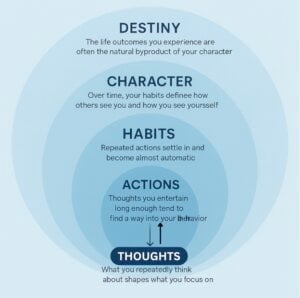
Think mental resilience ripple effect like throwing a pebble into still water.
The thought is the initial drop.
The first rings are your actions.
The expanding circles are your habits.
They grow wider into your character.
Eventually, the ripple reaches the far edge – your destiny.
Every choice in your head today sends waves out into your future.
Even the smallest mental shift creates movement that touches everything else.
Benefits of Mental Resilience Ripple Effect
Clarity – You can see how today’s thinking links directly to tomorrow’s reality.
Control – You can create positive ripples instead of letting random ones dictate your path.
Confidence – You know lasting change comes from small, consistent choices.
Real Life Examples
From a single thought to a marathon – The idea “I could try running” turns into one jog. That becomes a weekly action, then a habit. Months later, the ripple has reached the shore: you’re crossing a marathon finish line.
Career ripple effect – “I want to do creative work” becomes one small weekend project. That builds into a habit of creating, which shapes a character of persistence, leading to a new career.
Relationship transformation – “I want us to have more joy” sparks a daily moment of laughter. Over time, that habit changes the tone of the entire relationship.
Strategy to Help Mental Health and Wellness
Notice the first drop. Identify the recurring thought sending out ripples.
Create a small wave. Pair it with one concrete action today.
Repeat for momentum. Each repetition strengthens the ripple.
Let the wave shape identity. See yourself as the kind of person who naturally does that action.
Watch the ripple reach your shore. The life change arrives as the natural end of the chain.
Mental Resilience Ripple Effect: 5-Step System
Step 1 – Protect the Water’s Surface
Guard what enters your mind. Disturbances start the ripples.
Step 2 – Make the First Drop Count
Turn a meaningful thought into action right away.
Step 3 – Strengthen the Ripples
Consistency builds bigger, more powerful waves.
Step 4 – Shape the Current
Your habits create the flow of your character.
Step 5 – Let the Shoreline Change
Your destiny is simply where the waves eventually land.
Call to Action:
Today, choose one recurring thought worth amplifying.
Turn it into one small action.
Keep repeating it until you can see – and feel – the ripple in your life.
What Other Experts Say
As one psychologist put it: “Habits are just ripples from yesterday’s choices – and they keep going until something new disturbs the water.”
Your job is to create the ripples you actually want.
Mental Health & Wellness
The ripple effect works both ways.
Negative thoughts can send out waves that drain your energy and damage your well-being.
Positive thoughts, repeated and acted on, can create waves that strengthen mental resilience and bring you peace.
My Experiences as a Psychiatrist and Therapist
I’ve seen people transform without a single “big breakthrough” moment.
One client replaced “I can’t handle this” with “I’ll take one small step.”
That thought changed her actions, her habits, and eventually how she saw herself.
Her life didn’t flip overnight – but the ripples kept building until her shore looked entirely different.
Mental Resilience Ripple Effect: FAQs
Q: Can a single thought really cause a ripple big enough to change my life?
A: Yes – because each thought sets off a chain reaction of actions, habits, and character shifts.
Q: What if my ripples are negative?
A: Introduce a new thought and act on it – new ripples overwrite old ones over time.
Q: How quickly can a ripple become a habit?
A: Usually 30-90 days of consistent action.
Q: Can I change my direction after years of the wrong ripples?
A: Absolutely – throw a new stone in the water and watch the new pattern form.
Q: Does this work for relationships?
A: Yes – small repeated acts can completely shift relationship dynamics.
Q: How do I keep momentum?
A: Focus on repeating the smallest action until it’s automatic.
Q: Do I have to believe the thought right away?
A: No – belief often grows as you see the ripples in action.
Conclusion
Your thoughts are the first drop in the water.
They set off a ripple that moves through your actions, habits, and character until it reaches the shore of your destiny.
Tiny mental choices today can – and will – create massive changes later.
Mental Resilient Therapy Ripple Effect Worksheet
Use the following Mental Resilience Therapy Ripple Effect worksheet to get ideas and gain momentum.
Sources
The idea of the ripple effect draws from multiple fields – including psychology, sociology, leadership development, and even the physical sciences – but there’s no single origin point. Below are some of the key influences and references worth exploring:
Physics & Natural World Comparison
The phrase comes from the visible way waves spread out in water when a pebble is dropped. Over time, it’s become a metaphor for how one decision, action, or event can send influence far beyond its starting point.
Social Psychology & Behaviour Research
In psychology, the ripple effect describes how one person’s behaviour, attitude, or choice can influence others, often triggering a chain reaction that extends well past the immediate moment.
Example: Research by Fowler and Christakis (2008), published in the New England Journal of Medicine, found that happiness can move through social networks like ripples – extending up to three degrees of separation.
Leadership & Education Applications
In leadership training, it’s used to illustrate how a leader’s conduct shapes the culture and performance of an entire team over time.
In education, the term refers to how the influence on one student or group can impact many others indirectly – such as in Kounin’s classroom management theory known as the “Ripple Effect.”
Personal Development & Coaching
Writers and coaches, including Stephen Covey and John Maxwell, have applied the ripple effect to self-improvement, showing how small, deliberate actions can compound into significant, wide-reaching changes.
Academic References
- Fowler, J. H., & Christakis, N. A. (2008).
Dynamic spread of happiness in a large social network: longitudinal analysis over 20 years in the Framingham Heart Study.
BMJ, 337, a2338.Found that happiness spreads through social networks up to three degrees of separation, like ripples.
- Christakis, N. A., & Fowler, J. H. (2007).
The spread of obesity in a large social network over 32 years.
New England Journal of Medicine, 357(4), 370–379.Demonstrates how behaviours and health outcomes ripple outward in social systems.
- Kounin, J. S. (1970).
Discipline and Group Management in Classrooms.Introduced the “Ripple Effect” in education: when a teacher corrects one student, nearby students adjust their behaviour too.
- Barsade, S. G. (2002).
The ripple effect: Emotional contagion and its influence on group behavior.
Administrative Science Quarterly, 47(4), 644–675.Shows how emotions spread within groups and impact team performance.
- Hatfield, E., Cacioppo, J. T., & Rapson, R. L. (1994).
Emotional Contagion. Cambridge University Press.Explores how moods and behaviours ripple through individuals and communities.
Practical & Popular References
- Covey, S. R. (1989).
The 7 Habits of Highly Effective People. Free Press.Uses ripple effect ideas to explain how small habits influence larger life outcomes.
- Maxwell, J. C. (2006).
The 360° Leader. Thomas Nelson.Discusses how leadership behaviours ripple outward through an organisation.
- Clear, J. (2018).
Atomic Habits. Penguin Random House.Focuses on compounding effects of small changes – essentially the ripple effect applied to habit building.
- Grant, A. (2013).
Give and Take. Penguin.Shows how acts of generosity ripple through networks, creating positive cycles.
- Sinek, S. (2009).
Start With Why. Portfolio.Emphasises setting clear intentions that inspire ripple effects in leadership and culture.